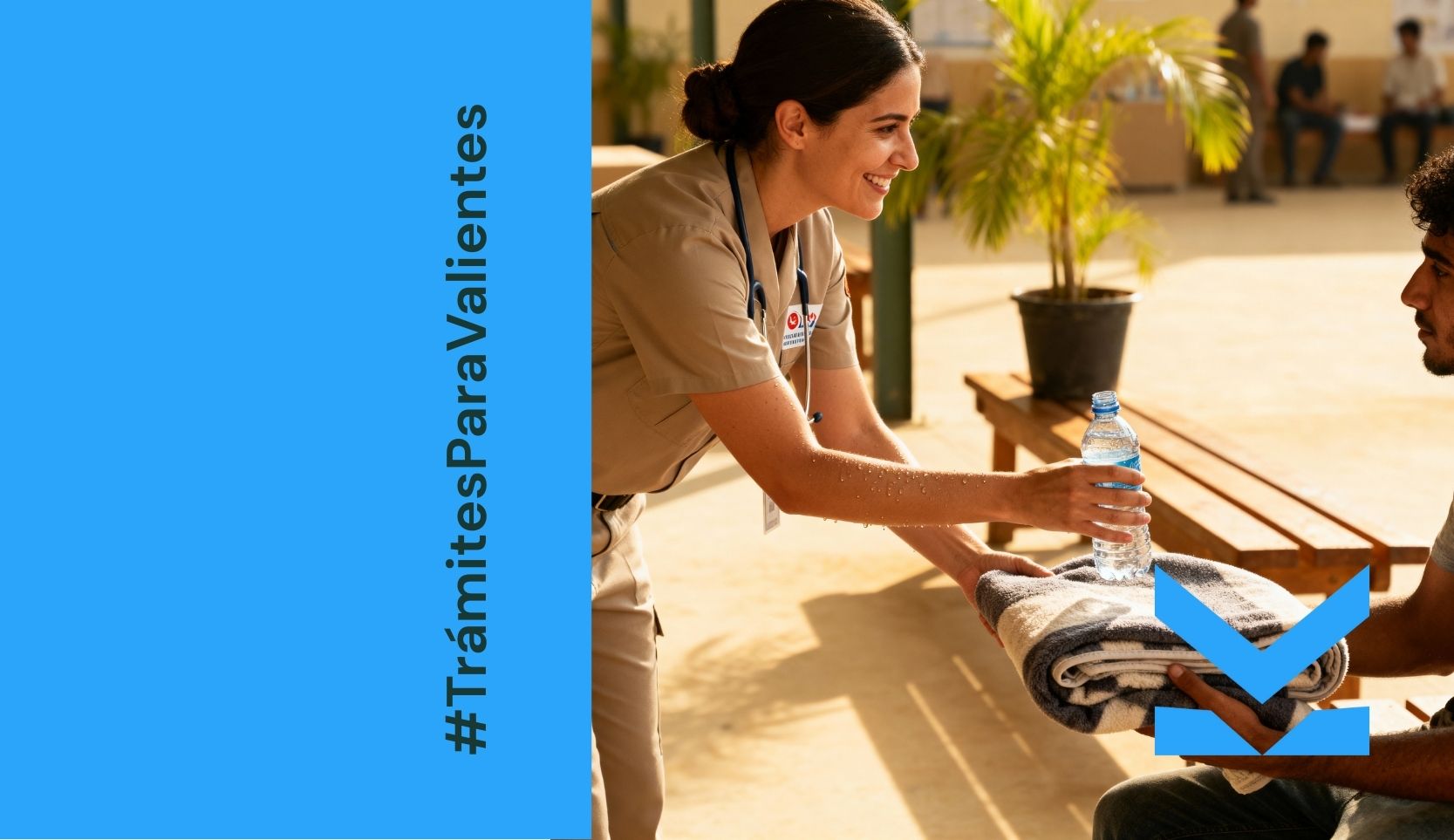
The humanitarian aid programmes exist to do more than deliver food or cover emergencies: they are a bridge of stability for those of us who have had to leave our homes, cross borders or face situations of vulnerability.
For many migrants and refugees, These programmes represent the first space where we can breathe, regain strength and receive real support after a journey full of uncertainty.
Organisations work every day to ensure that those of us who arrive without resources find temporary shelter, legal guidance, medical care and human accompaniment.
Their work not only meets urgent needs; it also restores dignity and opens up the possibility of a fresh start.
In this article we will explain how these programmes work, what kind of help they offer and how to access them, always keeping in mind those of us who need a point of support while we rebuild our history.
What is a humanitarian aid programme?
A humanitarian aid programme is a set of actions aimed at supporting people in critical situations: displacement, emergencies, disasters, economic crises or complex migration processes.
Its purpose is to provide a quick and dignified response when someone needs to cover the essentials to move forward.
These programmes are designed to meet immediate needs, without complicated procedures and with a very concrete approach: protecting life, ensuring safety and stabilising those at risk.
For this reason, they often offer basic food, a safe place to sleep, first-response medical care, legal advice and psychological support when necessary.
Unlike other forms of social assistancethe humanitarian aid focuses on the urgent. It seeks to ensure that a person can recover the control of their situation and, from there, begin to build a more stable path.
It doesn't solve the whole of life, but it does cover the moment when any support makes a huge difference.
What kind of support these programmes usually offer

The humanitarian aid programmes They do not all work in the same way, but they share a common goal: to meet the basic needs of those of us who have arrived with little or no stability.
Therefore, its support is organised in different areas that allow each case to be dealt with according to the urgency and the personal situation.
Support to cover essential needs
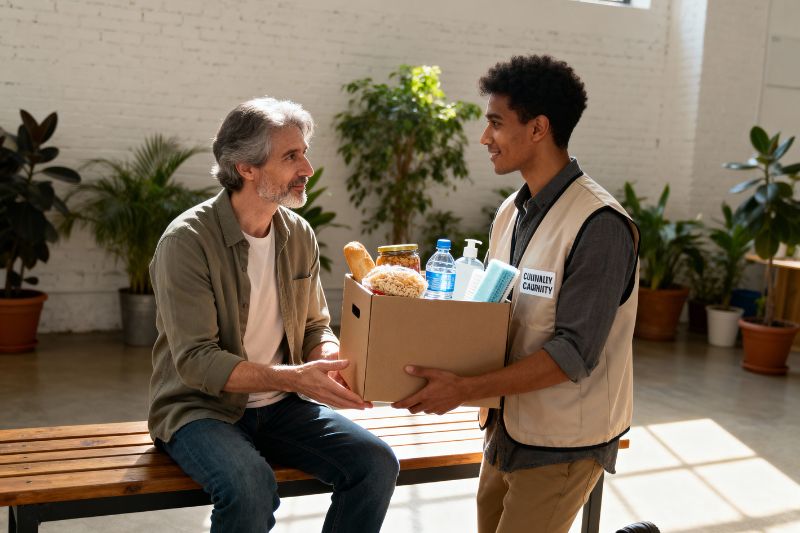
Many of the people who access these programmes we do it after long routes or crisis situations. In response to this, immediate remedies are offered such as:
- Basic food packages.
- Drinking water.
- Personal hygiene items.
- Clothing or blankets in cold or emergency contexts.
These are simple elements, but necessary for ensuring well-being in the early days.
Basic medical care
A large part of the beneficiaries we arrive with health problems resulting from travel, stress or lack of prior care. As a result, these programmes often facilitate:
- Primary medical consultations.
- Essential medicines.
- Healing and first aid.
- Referral to more specialised health centres.
It is a help designed to stabilise, not to replace medical systems, but it makes a difference in critical situations.
Legal guidance and protection procedures
For those of us in migratory processes or asylum, The right information is as important as food or shelter.
These programmes offer:
- Clear explanation of rights.
- Accompaniment in procedures.
- Support to fill forms.
- Guidance on steps to be taken on a case-by-case basis.
They do not decide the outcome of the processes, but they do help us to face it more clearly.
Safe spaces and temporary accommodation
When we have nowhere to stay, the programmes can facilitate:
- Emergency shelters.
- Short stays in protected areas.
- Temporary accommodation while a safe route is being defined.
This type of support allows you to rest, recover energy and avoid risks on the street or in dangerous environments.
Emotional and psychological support
Many crises leave invisible traces. That is why some programmes provide:
- Emotional containment.
- Basic psychological support.
- Activities for children and families.
- Spaces to reduce anxiety or stress.
This type of aid allows us to process what we have experienced and begin to organise our minds as well as our practical lives.
How to access a humanitarian aid programme without complication

Accessing a humanitarian aid programme is often simpler than it seems, especially when we know where to look and what information to take with us.
Many of us arrive with doubts, fear or confusion, but these programmes are designed precisely to guide us from the very beginning.
Go to the official points of attention
The programmes The most trusted and reliable are usually operating in visible and recognisable locations. These include:
- Care centres linked to UNHCR, where they provide counselling for people in need of international protection.
- Spaces for Red Cross, The company is present at borders, stations, terminals and urban centres, offering immediate basic assistance.
- Venues of Caritas, which provide social support and accompaniment to people without resources.
- Shelters run by churches or community organisations, which often work in coordination with humanitarian networks.
- Mobile service points, installed by international programmes when there are high migration flows.
In all of these spaces, they are served directly, without the need for intermediaries.
Bring any documents you have, even if they have expired.
The humanitarian teams understand that many of us have lost documents or did not have the opportunity to renew them.
Even so, if we have one of these, it can make the process easier:
- Passport.
- National identity card.
- Birth certificate.
- Any document that identifies you.
If we don't have one, we can still ask for assistance: the priority is our safety, not the paperwork.
Explaining our need in a simple and straightforward way
In these programmes work in teams that are trained to listen without judgement and to quickly identify what kind of support we need.
They will ask:
- If we come from a long journey.
- If you are travelling alone or with your family.
- If we need food, medical care, a safe place or legal advice.
We don't need to have perfect answers: it is enough to tell the essential.
Ask what help is available in our case
Each organisation has its own criteria and resources. For example:
- UNHCR can provide guidance on asylum and protection issues.
- Red Cross provides basic medical care, first aid, water and food.
- Caritas offers listening, social accompaniment, clothing and, in some places, temporary shelter.
The most useful thing to do is to ask us directly: “What help can we get right now?”
Maintain an active contact number
Many organisations follow the process by phone o messagesThe number of the number: appointments, deliveries, appointments, appointments or reminders. Even if it is a provisional number, we must keep it available.
Remember: humanitarian aid is always free of charge
No legitimate organisation, neither UNHCR, Red Cross, Caritas, churches, nor community shelters, will charge us for registering, counselling, delivering food or assigning shelter.
If someone asks for money, they do not belong in the programme.
What can migrants and refugees expect from this support?
The humanitarian aid programmes do not promise complete solutions, but they do offer something essential: a stability point from which to reorganise life.
For us, migrants or refugees, that first impulse can make the difference between moving forward or being trapped in uncertainty.
Immediate attention to the urgent
The first thing we usually get when we access these programmes is relief. A place to rest, something to eat, a basic medical consultation or someone to explain what to do next.
It is a response designed to cover the essentials without delay.
Clear information for decision-making
Many migrants, Like us, they arrive without knowing what rights they have, what procedures are possible or how to regularise their situation.
In the humanitarian programmes we receive simple explanations, in our own language where possible, and step-by-step guidance so that we do not get lost in complex processes.
Accompaniment in difficult times
For those of us who have lived through situations of violence, danger or family separation, these spaces offer emotional support and basic psychological support.
It is not deep therapy, But it is a listening that helps to stabilise and regain strength.
A bridge to the next stage

The humanitarian assistance is not the final destination. Its function is to allow us to have the minimum necessary to take the next step: looking for a job, finding a permanent place to live or initiating migration procedures.
Receive humanitarian aid is not a sign of weakness; it is a way of taking a breath of fresh air to move forward.
At Curiara, We know that every person who migrates carries with them a story of courage and a quest.
The humanitarian aid programmes They don't solve everything, but they do offer something essential: a moment of respite, a safe place and a guide to rebuild what comes next.
We believe in accompany to those they care for from afar, but also in being there for those in need of immediate support.
Curiara: here, to cross shores with you.